
Robotics Fundamentals · Lesson 11
End Effectors & Tooling
Est. 50–65 min
Why
Why the tool decides what the robot can do
OSHA defines an end-effector as an accessory device or tool designed to attach to the robot’s wrist or tool-mounting plate so the robot can perform its intended task — for example a gripper, spot-weld gun, arc-weld gun, spray-paint gun, inspection camera or adhesive dispenser. The same arm becomes a welder, a painter or a packer just by changing it, as you saw with the sand-raking KUKA in Lesson 1.
By the end you will be able to: name the main end-effector families and when to use each; compute the squeeze force a two-finger friction gripper needs (with acceleration and a safety factor); turn a servo’s torque into finger force; compute a suction cup’s holding force from pressure and area; check the wrist payload budget; and build and tune a gentle servo gripper on the bench.
Concept
End-effectors in plain words: the robot’s hands and tools
Think of a kitchen. You don’t use one tool for everything: tongs for hot rotis, a spatula for dosa, a ladle for dal, a magnet clip for the fridge door, a suction hook on the tiles. Each tool suits the object’s shape, surface and fragility. Robots are the same — and choosing the end-effector is often harder than choosing the arm.
The end-effector families
| Type | How it holds | Good for | Not good for |
|---|---|---|---|
| Two-finger parallel / angular gripper | Friction (squeeze) or shape (fingers wrap) | Blocks, parts, tools | Very soft or very slippery items |
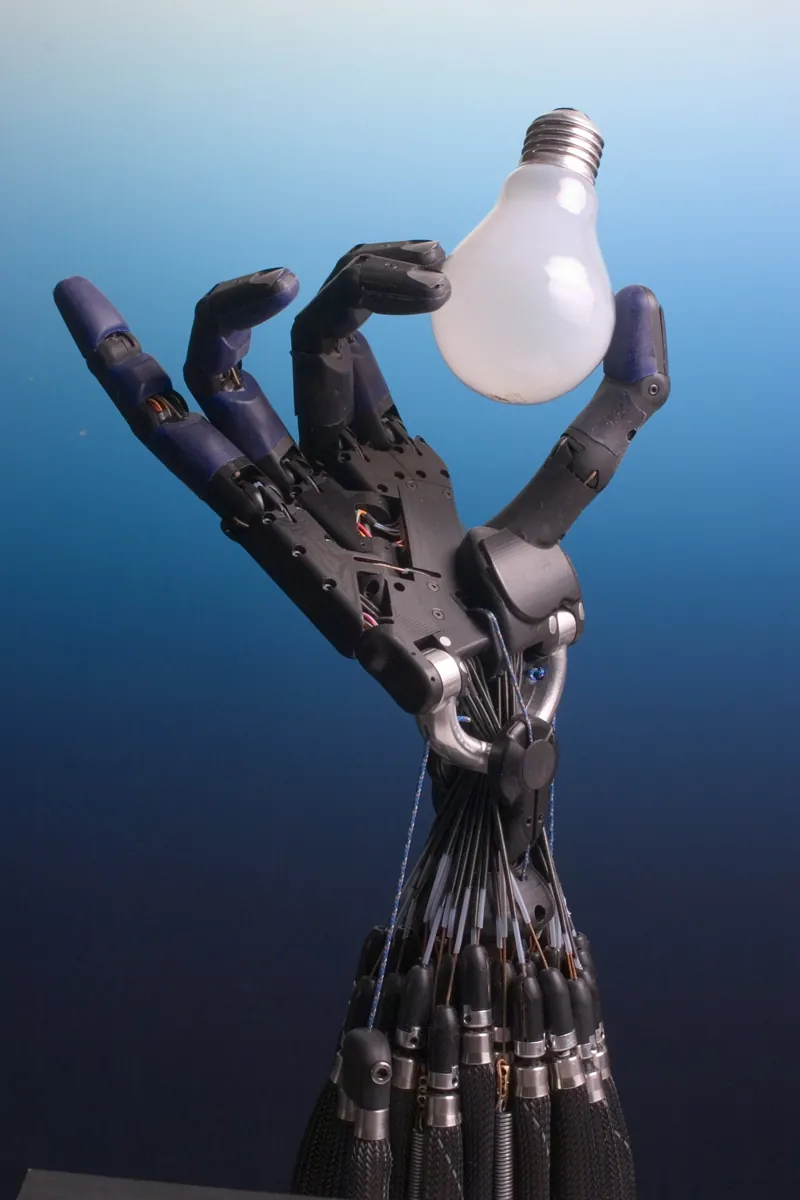
| Multi-finger hand | Many joints wrap around the object | Varied shapes, research, dexterous tasks | Cost, complexity, speed |
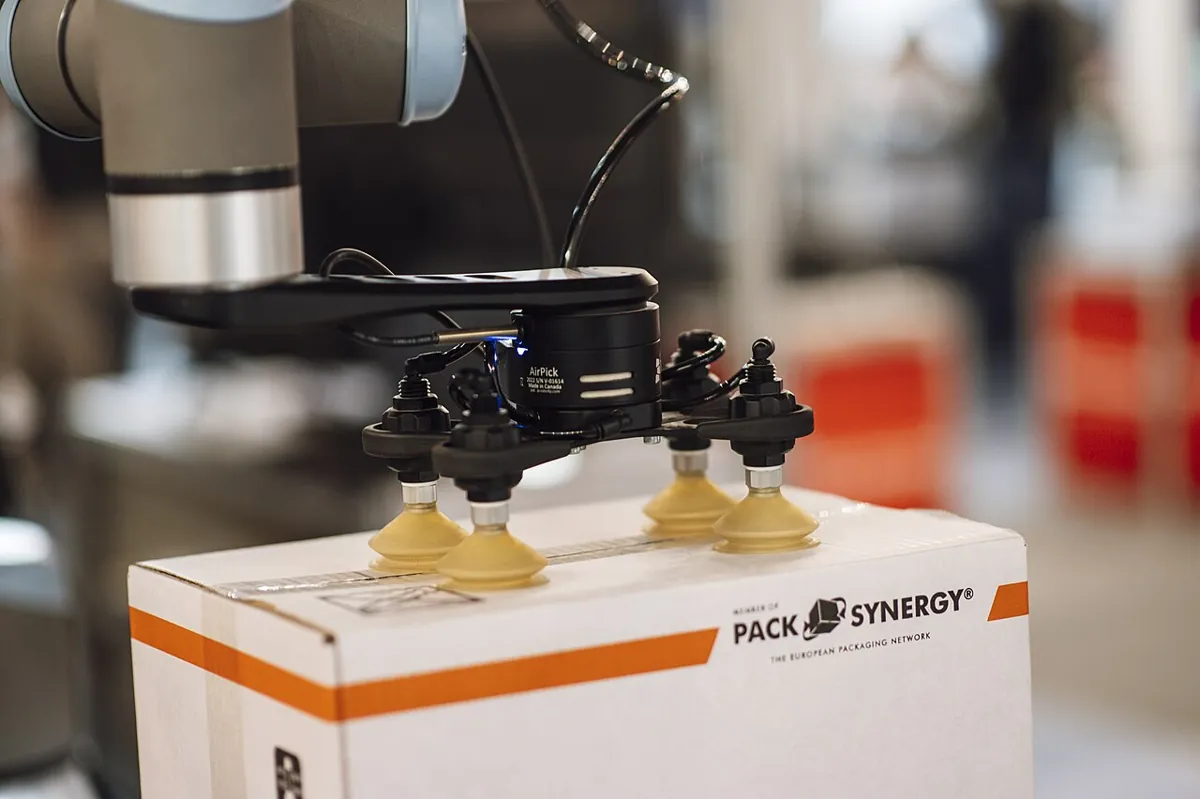
| Vacuum / suction cups | Air pressure difference | Boxes, sheets, glass, smooth flat surfaces | Porous, rough or very small parts |
| Magnetic gripper | Magnetic force | Steel sheets and parts | Non-ferrous materials |
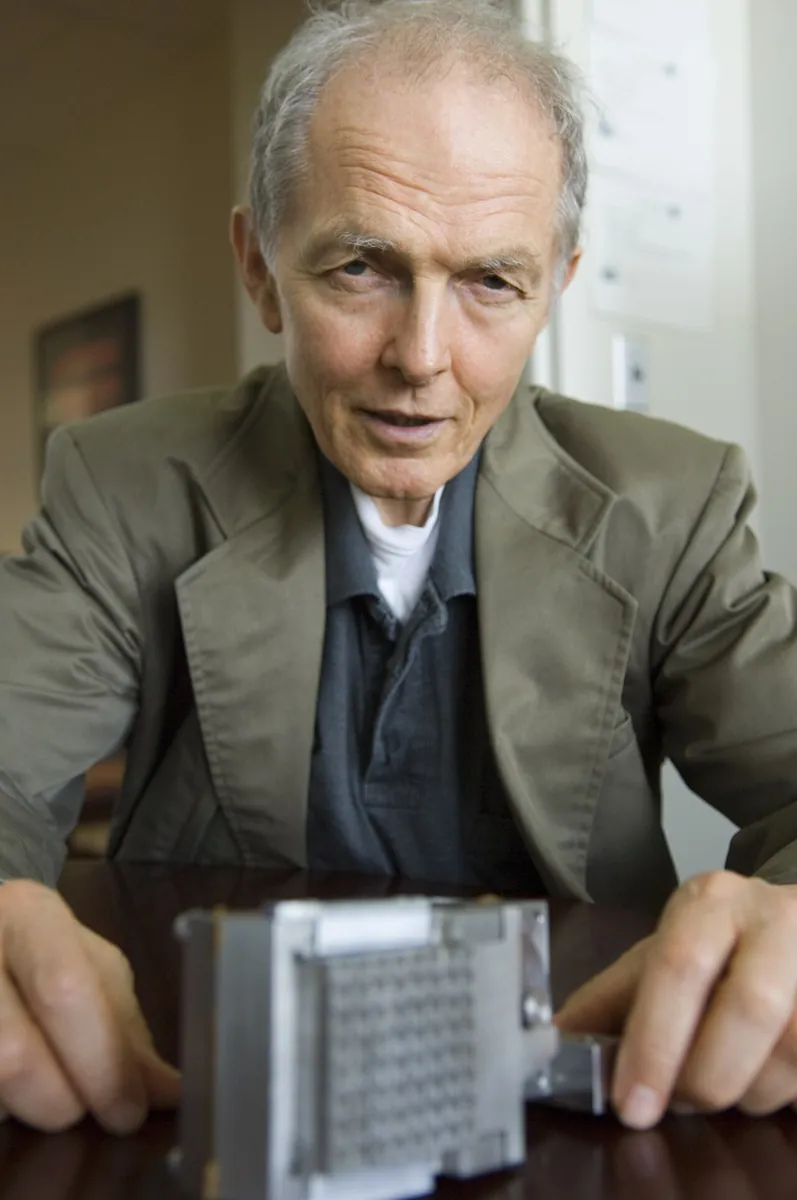
| Soft / conformal gripper | Flexible fingers or pins shape themselves to the object | Fruit, odd shapes, delicate items | High precision placement |
| Process tools | Not holding — doing | Welding guns, spray guns, screwdrivers, cameras, pens | Picking |
OSHA notes that industrial robot drives are usually electric, while pneumatic power (typically 80–90 psi air) is often used for end-effectors — grippers that snap open and closed with compressed air. Your desk arm will use a servo instead; the sizing ideas are the same.
How hard must the fingers squeeze?
A two-finger friction grip holds because of friction at both pads. OpenStax University Physics gives the rule: static friction can be at most μₛ × N, where μₛ is the coefficient of static friction and N the normal (pressing) force. Two fingers give two friction forces, so 2 μ F must beat the part’s weight — plus extra for acceleration and a safety margin:
F_finger ≥ m (g + a) × SF ÷ (2 μ)
- m = part mass (kg); g = 9.81 m/s²; a = upward acceleration when lifting (m/s²); SF = safety factor (2 is common for hobby work); μ = friction coefficient between pad and part (rubber on dry wood is high, plastic on wet plastic is low — measure or look it up for your materials).
Servo fingers: F_pad ≈ τ_servo ÷ r_lever
- A 0.25 N·m servo on a 2 cm lever gives about 12.5 N at the pad (before friction losses in the linkage). Too much force crushes; set the closed angle so the fingers just touch the part, and limit force by limiting how far past touching they go.
Suction cups
OpenStax defines pressure as force per unit area (p = F/A, measured in pascals, 1 Pa = 1 N/m²). Turn it around and a suction cup’s holding force is the pressure difference times the cup area. Atmospheric pressure is about 101.3 kPa, so no vacuum can push harder than that — in practice cups work with tens of kPa below atmospheric.
F_cup = Δp × π (d/2)²
- Δp = how far below atmospheric the cup pulls (Pa); d = cup diameter (m). 30 mm cup at 40 kPa → 28.3 N, enough for about 1.4 kg with SF 2 (if the surface seals well).
Payload budget
The gripper counts against the arm’s payload. If your arm can carry 150 g at the wrist and the gripper weighs 60 g, only 90 g is left for the part — and every gram at the wrist adds shoulder torque (Lesson 5). Light grippers make strong arms.
Visual
Visualise it: pick the right gripper
Try different grippers on different objects. Notice how the object’s **shape, surface and weight** decide which gripper works — and how grip force and friction work together.
Interactive · Gripper explorer · Educational

Two fingers close on opposite faces — great for boxes; needs good width clearance.
Educational gripper toy — not CAD / not force-closure solver.
Code lab
Code lab: will the gripper hold the part?
The script sizes four grips: finger force for four parts (with example friction coefficients), servo torque turned into pad force, three suction cups, and a wrist payload budget. Run it with python3 gripper_sizing.py.
"""gripper_sizing.py - will the gripper hold the part?
Two-finger friction grip: each finger presses with F; friction can hold up to 2 * mu * F.
Need 2 * mu * F >= m * (g + a) * SF   ->   F >= m * (g + a) * SF / (2 * mu)
Suction cup: holding force = pressure difference x cup area (pressure = force / area)."""
import math

G = 9.81
SF = 2.0          # safety factor

def finger_force(mass, mu, accel=0.0):
    return mass * (G + accel) * SF / (2 * mu)

print("== Two-finger gripper: squeeze force needed per finger ==")
print("part                 mass   mu    lift accel  force/finger")
for part, m, mu, a in [("foam block", 0.020, 0.6, 0.0), ("wooden cube", 0.050, 0.4, 0.0),
                       ("wooden cube, fast lift", 0.050, 0.4, 5.0), ("plastic bottle (wet)", 0.150, 0.2, 2.0)]:
    print(f"{part:22s} {m*1000:4.0f} g {mu:4.1f}   {a:4.1f} m/s^2   {finger_force(m, mu, a):5.2f} N")

print("\n== Servo-driven fingers: torque -> squeeze ==")
servo_torque, horn = 0.25, 0.02   # N.m (example), lever from servo axis to finger pad (m)
f = servo_torque / horn
print(f"{servo_torque} N.m on a {horn*100:.0f} cm lever -> {f:.1f} N at the pad (before losses)")

print("\n== Suction cup ==")
for d_mm, dp_kpa in [(20, 40), (30, 40), (30, 60)]:
    area = math.pi * (d_mm / 2000) ** 2
    force = dp_kpa * 1000 * area
    print(f"cup {d_mm} mm, vacuum {dp_kpa} kPa below air -> {force:5.1f} N -> holds {force/(G*SF)*1000:5.0f} g with SF {SF}")

print("\n== Payload budget at the wrist ==")
rated_payload, gripper_mass = 0.150, 0.060   # example arm and gripper - use your datasheet
for part in (0.050, 0.100):
    total = gripper_mass + part
    print(f"gripper {gripper_mass*1000:.0f} g + part {part*1000:.0f} g = {total*1000:.0f} g -> {'OK' if total <= rated_payload else 'OVER the rated payload'}")
Output (run with python3 gripper_sizing.py)
== Two-finger gripper: squeeze force needed per finger ==
part                 mass   mu    lift accel  force/finger
foam block               20 g  0.6    0.0 m/s^2    0.33 N
wooden cube              50 g  0.4    0.0 m/s^2    1.23 N
wooden cube, fast lift   50 g  0.4    5.0 m/s^2    1.85 N
plastic bottle (wet)    150 g  0.2    2.0 m/s^2    8.86 N

== Servo-driven fingers: torque -> squeeze ==
0.25 N.m on a 2 cm lever -> 12.5 N at the pad (before losses)

== Suction cup ==
cup 20 mm, vacuum 40 kPa below air ->  12.6 N -> holds   640 g with SF 2.0
cup 30 mm, vacuum 40 kPa below air ->  28.3 N -> holds  1441 g with SF 2.0
cup 30 mm, vacuum 60 kPa below air ->  42.4 N -> holds  2162 g with SF 2.0

== Payload budget at the wrist ==
gripper 60 g + part 50 g = 110 g -> OK
gripper 60 g + part 100 g = 160 g -> OVER the rated payload
Real world
End-effectors in real robots
- Car factories: spot-welding guns as end-effectors (Lesson 1’s BMW photo).
- Warehouses and packing: vacuum grippers for cartons; OSHA notes pneumatic power is often used for end-effectors.
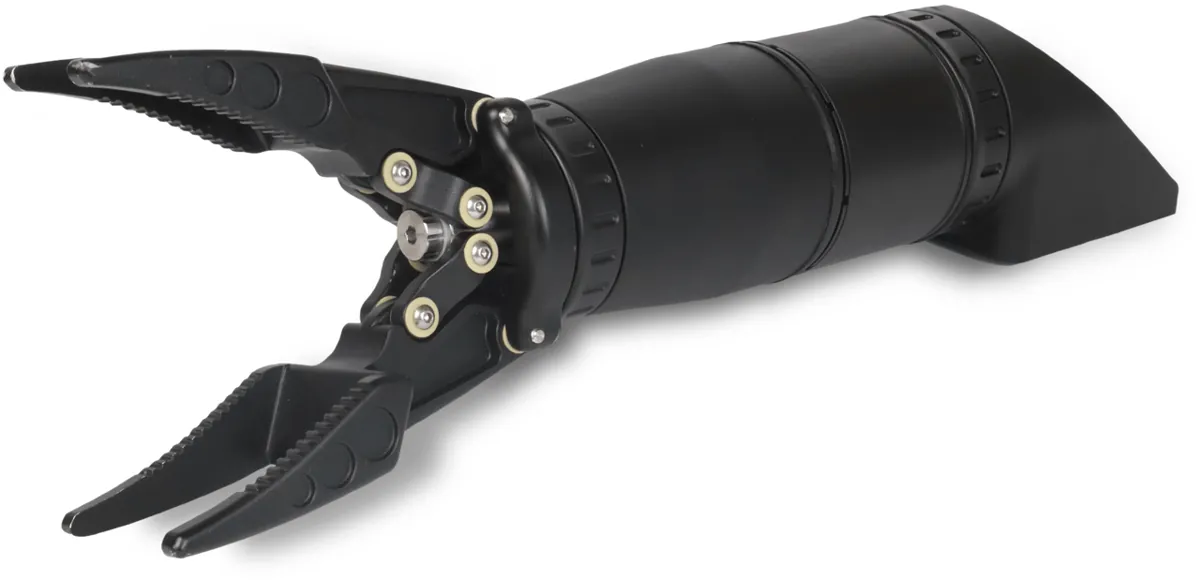
- Underwater work: rugged claws on ROVs for subsea intervention.
- Research labs: dexterous multi-finger hands for varied objects.
- Space and odd shapes: NASA’s conformal gripper idea — one gripper that adapts to many shapes instead of a special tool for each.
Bench build
Bench build: a gentle servo gripper
Build or reuse a servo-driven two-finger gripper (a kit gripper or a cardboard/ice-cream-stick one). A push-button toggles open/close, and the servo moves in 1° steps so you can see exactly when the fingers touch.
Wire
Servo signal → pin 9. Servo power from a separate 5–6 V supply; supply GND joined to Arduino GND. Push-button between pin 2 and GND.
Find OPEN
Upload
servo_gripper.ino. AdjustOPEN_DEGuntil the fingers are wide enough for your largest part.Find CLOSED per part
With a 3 cm block between the fingers, increase
CLOSED_DEGby 5° at a time until the fingers just touch. Add 3–5° for grip. Write the number.Test the grip
Lift the block slowly by hand-moving the gripper, then quickly. Does it slip? Add a rubber pad (a cut piece of balloon or rubber band) and test again.
Try three parts
Repeat for a foam piece and a small plastic bottle. Make a table of part, closed angle, slip yes/no.
// servo_gripper.ino - a gentle servo gripper: press the button to toggle open/close.
// Button between pin 2 and GND (internal pull-up). Servo signal on pin 9.
// Servo power from a separate 5-6 V supply, grounds joined. Find OPEN/CLOSED by testing slowly.
#include <Servo.h>

Servo grip;
const int OPEN_DEG = 40;      // fingers apart
const int CLOSED_DEG = 110;   // fingers touching a 3 cm block - do NOT drive past the part
bool closed = false;
int angle = OPEN_DEG;

void moveSlowly(int target) {
  while (angle != target) {
    angle += (target > angle) ? 1 : -1;
    grip.write(angle);
    delay(10);
  }
}

void setup() {
  Serial.begin(9600);
  pinMode(2, INPUT_PULLUP);
  grip.write(OPEN_DEG);
  grip.attach(9);
}

void loop() {
  if (digitalRead(2) == LOW) {
    delay(30);                          // simple debounce
    if (digitalRead(2) == LOW) {
      closed = !closed;
      moveSlowly(closed ? CLOSED_DEG : OPEN_DEG);
      Serial.println(closed ? "closed" : "open");
      while (digitalRead(2) == LOW) {}  // wait for release
    }
  }
}Debugging
Debugging grippers
| Symptom | Likely cause | Fix |
|---|---|---|
| Part slips out | Too little squeeze or low friction | Rubber pads; a few degrees more closing; slower lifts |
| Part is crushed or dented | Closing angle far past touching | Find the touch angle per part; stop 3–5° past it |
| Servo buzzes and heats while holding | Stalling against the part | Open slightly; use a lower closed angle |
| Suction cup won’t hold | Rough, porous or curved surface; leak | Choose a softer or bellows cup; clean the surface; check the hose |
| Part tilts in the grip | Fingers grab off-centre | Grip through the centre of mass; widen the pads |
| Arm sags after adding the gripper | Payload budget exceeded | Lighter gripper or part; re-check shoulder torque (Lesson 5) |
Think
Think about it
Think
Arjun must pick three things with one desk arm: a 20 g cardboard box, a 40 g round lemon and a flat 30 g steel washer. He has a two-finger servo gripper and a small suction cup. Which tool for which object, and what would you change so one tool can do all three?
Experiment
Try it in the lab: size a grip and test it
Thirty minutes with the gripper explorer, the sizing script and — if you have one — a servo gripper on the bench.
Experiment
Size a grip and test it
You will need
- Gripper explorer (below, runs in your browser)
- Kitchen scale, three test objects, rubber bands or balloon pieces for pads
- Optional: `gripper_sizing.py`; servo gripper, Arduino, push-button, 5–6 V supply
Steps
- In the explorer, try each gripper on each object. Write which work and why.
- Weigh your three test objects. Estimate μ for each against your pads (tilt test).
- Add your objects to `gripper_sizing.py` and run it. Write the required finger force for each.
- On the bench, find the touch angle and the holding angle for each object with `servo_gripper.ino`.
- Lift each object slowly and quickly. Record slips. Do faster lifts slip more, as the formula predicts?
Interactive · Gripper explorer · Educational
Two fingers close on opposite faces — great for boxes; needs good width clearance.
Educational gripper toy — not CAD / not force-closure solver.
The tool, not the arm, decides whether a pick succeeds. Grip force depends on mass, acceleration, friction and safety margin; suction depends on pressure difference and area; and every gram of gripper reduces what the arm can carry.
Knowledge check
Check your understanding
Knowledge check
1. OSHA defines an end-effector as…
2. Static friction at one finger pad can be at most…
3. A 50 g part, μ = 0.4, SF = 2, lifted slowly. Required force per finger is about…
4. Lifting the same part faster (upward acceleration) means the grip force must…
5. A suction cup’s holding force is…
6. Doubling a suction cup’s diameter (same vacuum) multiplies the force by about…
7. OSHA notes that end-effectors are often powered by…
8. Your gripper servo buzzes and gets warm while holding a small block. You should…
9. Why does the gripper’s own mass matter?
10. Which end-effector suits flat, sealed cartons best?
Mini assignment
Hands-on assignment
Mini assignment
Choose, size and test a gripper for three parts
Pick three real objects of different shapes and surfaces, choose an end-effector for each (or one that handles all), size the grip, and test it on the bench or with a hand-held model.
Deliverables
- A table: object, mass, surface, chosen end-effector, required force (from the script) and reason.
- Your edited `gripper_sizing.py` output with your three objects.
- Your bench table: object, touch angle, holding angle, slip test result — or, without hardware, a hand-squeeze test with a spring scale.
- A sketch of a final gripper design (pads, finger shape, opening width) and its mass, checked against a payload budget.
Do this, step by step
- Pick three objects with different shapes and surfaces (for example a pen, a small box and a ball) and weigh each one.
- For each, choose an end-effector (two-finger, suction, soft or hook) and write one reason.
- Put the masses, friction values and acceleration into
gripper_sizing.py, run it and copy the required grip force. - Bench test with
servo_gripper.ino(servo on its own supply, common ground): find the touch angle, the holding angle, and do a gentle shake slip test. - Sketch the final gripper (pads, finger shape, opening width), estimate its mass and check it fits the arm’s payload budget.
Stuck? Hints, one at a time
- Hint 1: Start with the hardest object (heaviest, most slippery or most fragile) — it decides the design.
- Hint 2: Estimate μ with the tilt test: tan(slide angle) ≈ μ.
- Hint 3: Opening width must exceed the largest object by a centimetre or so; closing must reach the smallest.
- Hint 4: Add soft pads before adding force.
Challenges (pick by level)
- 🟢 Easy: Name the end-effector you would use for painting, welding, picking eggs and moving steel sheets.
- 🟢 Easy: Compute the holding force of a 20 mm cup at 50 kPa.
- 🟡 Medium: In
servo_gripper.ino, store a closed angle per object and select it with a second button. - 🟡 Medium: Using the script, find the lowest μ at which your servo can still lift the bottle with SF 2.
- 🟠 Hard-ish: Add a simple force sensor (a force-sensitive resistor under one pad, read on A0) and stop closing when it passes a threshold.
- 🔴 Hard: Design a V-notch finger that holds round objects by shape rather than friction. Explain with a free-body sketch why it needs less squeeze.
- ⚫ Expert: Compare the payload and grip requirements of a vacuum gripper and a two-finger gripper for a 300 g carton accelerating at 3 m/s². Include the gripper masses and the effect on shoulder torque from Lesson 5.
Next step
You have bodies, sensors, loops, frames and tools. In Lesson 12 — Robot Platforms Compared you step back and compare whole robots — arms, rovers, gantries, drones and humanoids — and choose the right one for a job with numbers, not hype.
Look back: Lesson 10: Frames, Pose & Tool Center Point. Next: Lesson 12: Robot Platforms Compared. Related: Stage 13 — Perception, Planning & Manipulation and Stage 6 — 6DOF Arm.
Sources
- OSHA Technical Manual, Section IV Chapter 4 — end-effector definition and examples; drives usually electric; pneumatic power (typically 80–90 psi air) often used for end-effectors.
- OpenStax University Physics Volume 1, 6.2 Friction — static friction f_s ≤ μ_s N.
- OpenStax University Physics Volume 1, 14.1 Fluids, Density, and Pressure — pressure p = F/A; 1 Pa = 1 N/m²; atmospheric reference of 101.3 kPa.
- SparkFun Learn: Hobby Servo Tutorial — servo current rises with mechanical load; a stalled servo strains the supply.
- Photos: Wikimedia Commons (credits under each image).
Self-attested for now — keep artifacts in your lab notebook.
Complete
Today's goal
0 of 1 done today
Mark this lesson complete when you have worked the experiment, knowledge check, and assignment (even roughly).